.svg)

Why Electric Propulsion Is Reshaping Pontoon Boating
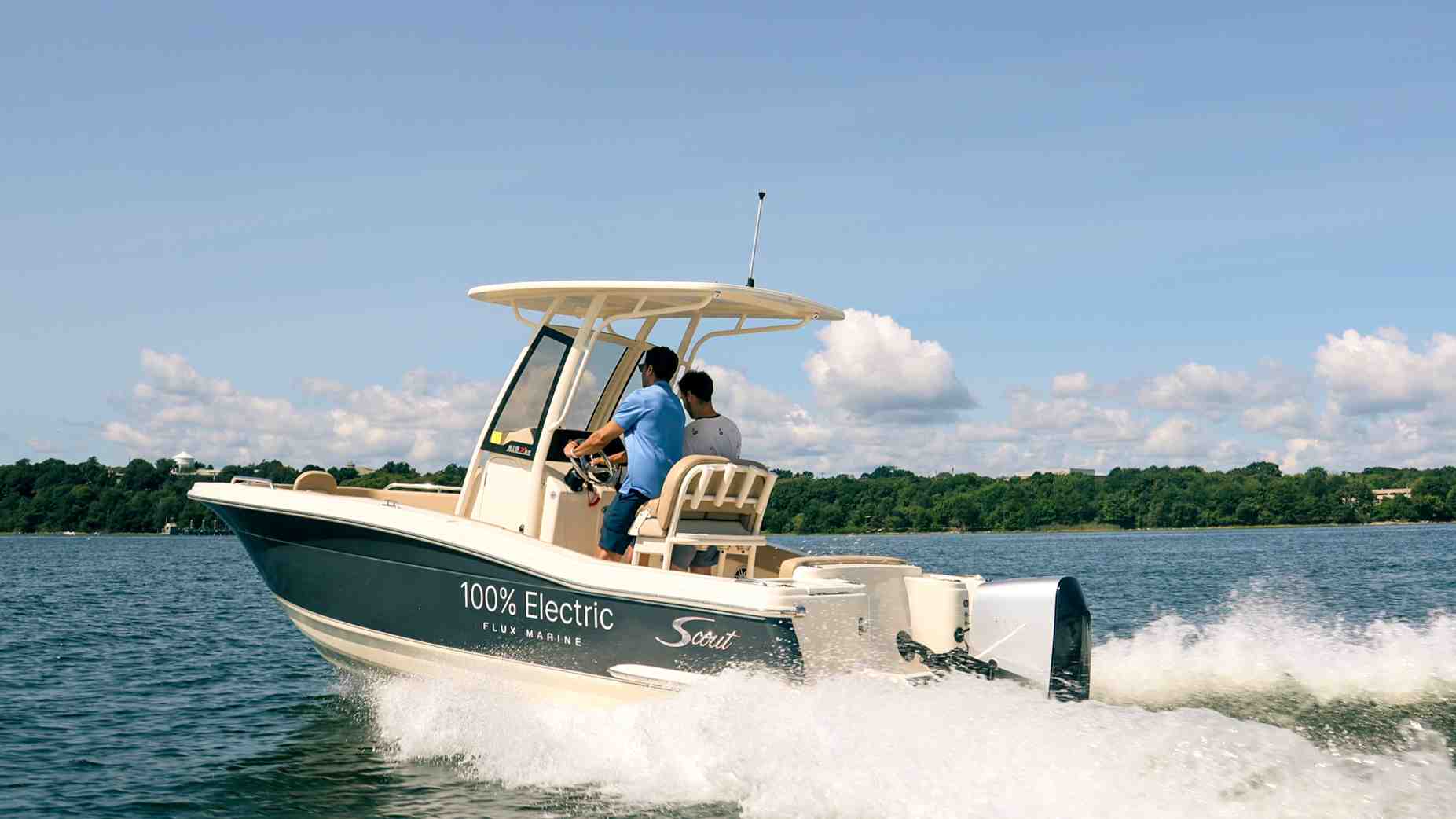
An electric motor for pontoon boats delivers quiet operation, zero emissions, instant torque, and significantly lower maintenance compared to traditional gas engines. Electric outboards now offer enough power for cruising, tubing, and all-day use—while eliminating fuel costs, oil changes, and engine noise.
Top Electric Motor Options for Pontoons:
Motor TypeBest ForKey AdvantageLow-power (7.5e–20e)Smaller pontoons, calm watersAffordable entry point, easy chargingMid-power (35e–50e)Standard recreational pontoonsBalances range and performanceHigh-output (75e+)Larger pontoons, commercial useMatches gas engine performance
Pontoon boats are ideal candidates for electric propulsion. Their wide, stable hulls and moderate speeds align perfectly with the strengths of modern electric outboards. You get smooth acceleration, whisper-quiet cruising, and the ability to steer waterways where gas engines are restricted—all without sacrificing performance.
The technology has matured rapidly. Electric motors now provide real-world range for full-day outings, integrated digital controls with GPS-based range estimates, and battery systems designed for marine durability. Maintenance drops to nearly zero—no winterization, no oil changes, no carburetor cleaning.
As Benjamin Sorkin, founder of Flux Marine, I've spent nearly a decade engineering high-performance electric outboards that match or exceed gas engines in real-world boating conditions. Through hands-on development and testing across recreational and commercial applications, I've seen how an electric motor for pontoon use transforms the on-water experience while delivering long-term cost savings and reliability.
Why Choose an Electric Motor for Your Pontoon Boat?
Choosing an electric motor for pontoon boats isn't just about adopting new technology; it's about enhancing the entire boating experience. The benefits extend far beyond simply moving your boat, touching on aspects of enjoyment, environmental responsibility, and practical ownership. We've seen how electric propulsion systems are making boating more accessible and enjoyable for a wider range of enthusiasts, from the casual weekend cruiser to the dedicated angler.
The primary advantages of electric propulsion systems for pontoons include:
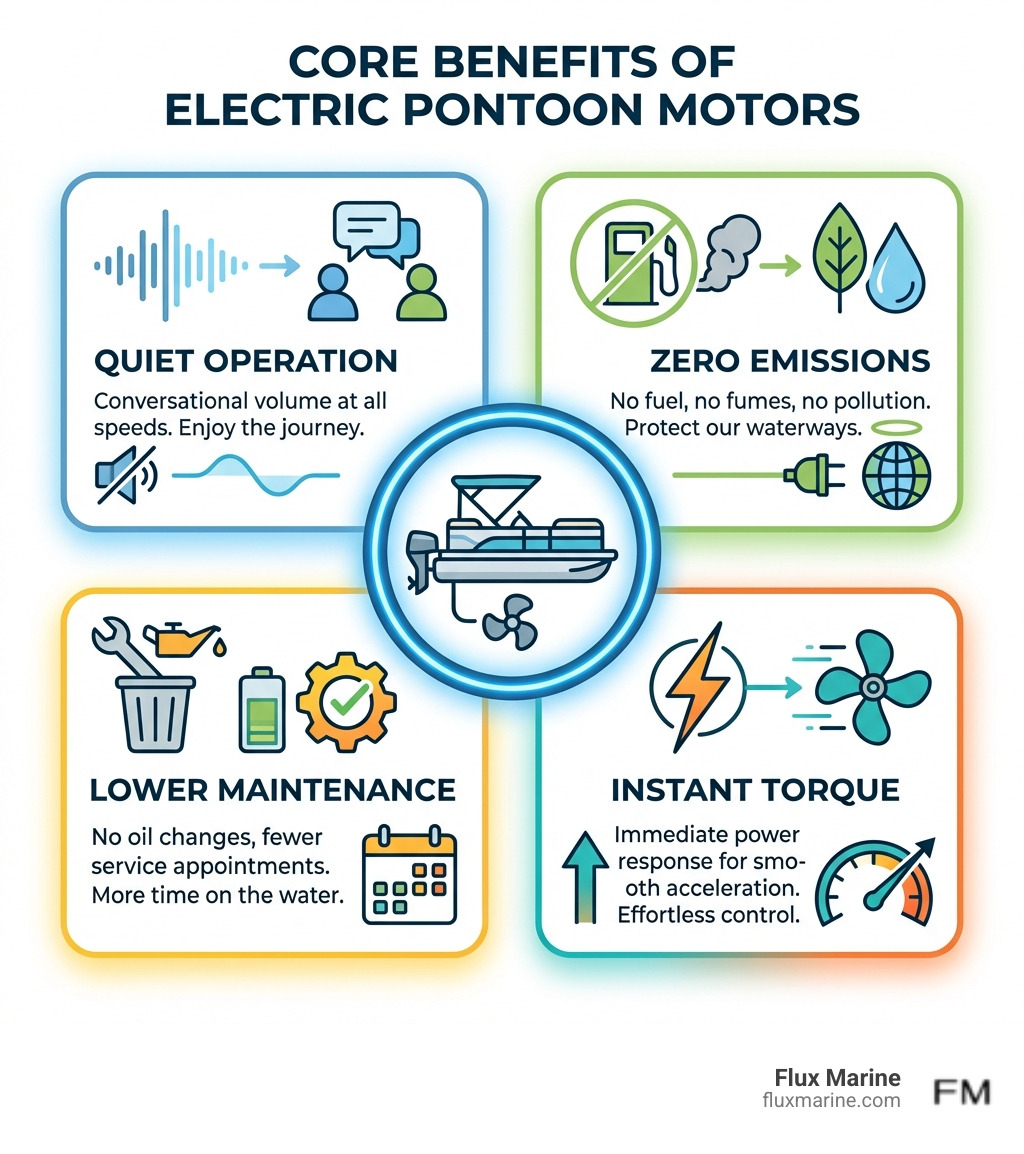
- Quiet Operation: Electric motors run with minimal noise, allowing for conversations at normal volumes, undisturbed wildlife viewing, and a more peaceful escape on the water.
- Zero Emissions: Without burning fossil fuels, electric pontoons produce no exhaust fumes, odors, or harmful pollutants, contributing to cleaner air and water.
- Instantaneous Power Delivery: Electric motors deliver full torque from zero RPM, providing smooth, immediate acceleration and precise control, which is particularly beneficial for docking or navigating crowded areas.
- Access to Restricted Waterways: Many lakes and rivers have bans or restrictions on internal combustion engines to protect sensitive ecosystems. Electric pontoons offer unrestricted access to these serene environments.
- Reduced Maintenance: With far fewer moving parts and no need for fuel, oil, or complex engine systems, electric motors drastically cut down on maintenance requirements and costs.
- Improved Social Experience: The absence of engine noise and fumes creates a more pleasant environment for passengers, fostering better communication and enjoyment on board.
These benefits collectively transform a pontoon outing into a more serene, environmentally friendly, and ultimately more enjoyable experience. Whether we're cruising the calm waters of the Rhode Island coast or exploring the intricate waterways of Florida, the difference an electric motor makes is undeniable.
A Quieter, Cleaner Boating Experience
One of the most immediate and appreciated benefits of an electric motor for pontoon boats is the profound quietness. Imagine gliding across the water with only the gentle lapping of waves against the hull and the sounds of nature surrounding you. This is the reality of electric pontooning. Unlike gas engines that often require shouting over the roar, an electric motor allows for easy, conversational-level chatter among passengers. This improved tranquility fundamentally changes the social dynamic on board, making every trip a more relaxing and connected experience.
Beyond the auditory benefits, electric propulsion delivers a significantly cleaner boating experience. There are no exhaust fumes to contend with, no oily residues on the transom, and no worry about fuel spills contaminating the water. This minimal environmental impact is a core part of our mission at Flux Marine. We believe in contributing to a cleaner, quieter industry, and electric pontoons are a perfect embodiment of this philosophy. For boaters who cherish the natural beauty of our waterways—from the pristine lakes of New York to the estuaries of Virginia—an electric motor offers a way to enjoy these environments responsibly, leaving no trace behind.
Access to Restricted Waterways
A significant practical advantage of an electric motor for pontoon boats is the expanded access it provides to waterways with internal combustion engine (ICE) restrictions. Many smaller lakes, reservoirs, and sensitive ecological zones across the country, including areas popular in New Jersey and New York, have implemented bans or limitations on gasoline-powered boats. These regulations are often in place to preserve water quality, protect wildlife, or simply ensure a more peaceful environment for all users.
For pontoon owners, this often means being excluded from some of the most tranquil and beautiful boating locations. However, with an electric motor, these restrictions become a non-issue. Electric pontoons are welcomed in these areas, offering boaters the freedom to explore serene, often less crowded, bodies of water. This ability to steer internal combustion-restricted waterways makes electric motors perfect for smaller lakes and rivers, expanding boating opportunities and allowing for a truly quiet and eco-friendly boating experience, which aligns perfectly with the desires of many recreational boaters.
Evaluating Performance: Power, Range, and Batteries
When considering an electric motor for pontoon use, understanding performance metrics like power, range, and battery systems is crucial. Unlike gas engines, where horsepower is a familiar benchmark, electric motors are often rated in kilowatts (kW) or by an "e" designation (e.g., 35e), indicating an equivalent to traditional horsepower. However, the immediate, low-end torque of an electric motor often makes it feel more powerful than its direct horsepower equivalent, especially for getting a heavy pontoon boat moving smoothly.
The ideal power output for an electric motor will depend on several factors: the size and weight of your pontoon, how many passengers you typically carry, and your intended use. A smaller, lighter pontoon used for leisurely cruising on calm waters might perform excellently with a mid-power electric motor. Larger pontoons, or those used for towing water toys or navigating currents, will benefit from higher-output systems. We've engineered our systems to provide robust performance for a variety of pontoon sizes and applications, ensuring that whether you need power for a relaxing cruise or something more robust for a full day of activities, there’s an electric solution. For a deeper dive into how electric motors deliver their power, you can explore our insights on Understanding Torque.
Factors affecting range are equally important. These include battery capacity, boat speed, hull efficiency, weather conditions (wind, current), and total weight on board. A heavier load or higher speeds will naturally consume more battery power. Modern electric pontoon systems are designed to offer practical range for typical recreational use, often providing several hours of cruising at moderate speeds or shorter bursts of higher performance.
Matching an electric motor for pontoon use
Selecting the right electric motor for pontoon applications involves more than just looking at a single number. We often discuss thrust versus horsepower, but for electric motors, the immediate torque delivery is a game-changer. Our electric outboards provide instant power from a standstill, which translates to smooth, controlled acceleration – ideal for maneuvering a pontoon boat, especially in tight docking situations or when pulling away from the shore.
When it comes to cruising speed, electric motors excel at efficient, moderate speeds that are typical for pontoon use. While top speeds might be comparable to some gas engines, the efficiency curve of an electric motor means you can enjoy extended range at comfortable cruising paces. For those interested in towing, higher-output electric motors can easily handle tubers or wakeboarders, thanks to their consistent and strong torque delivery.
Depending on the size of your pontoon and your performance expectations, you might consider a single or dual motor setup. For many standard recreational pontoons, a single electric motor provides ample power and range. However, for larger pontoons or those seeking improved maneuverability and redundancy, a dual motor configuration can offer superior control and performance. Our electric motor for pontoon solutions are designed with flexibility in mind, allowing us to tailor the propulsion system to your specific pontoon and boating style.
Understanding Battery Systems and Charging
The heart of any electric pontoon boat is its battery system, and understanding its capabilities and charging infrastructure is key to a seamless electric boating experience. Modern electric pontoons use advanced lithium-ion battery packs, designed for marine environments to provide high energy density and long cycle life. Battery capacity is typically measured in kilowatt-hours (kWh), directly correlating to the amount of energy stored and, consequently, your boat's potential range.
Compared to traditional fuel-powered boats, which rely on gas tanks and fuel stations, electric pontoons use sophisticated battery management systems and charging methods. Most electric pontoon boats come equipped with onboard charging systems that can be plugged into standard shore power at a marina, similar to an RV. Many systems also offer home charging options, allowing you to charge your boat overnight in your driveway or garage. Charging times vary depending on the battery bank's size and the charger's power output, but often a full charge can be achieved overnight.
Safety is paramount, and electric marine battery systems are engineered with multiple layers of protection, including robust casings, thermal management, and sophisticated monitoring. As highlighted in our article Is Electric Boating Safe?, modern battery technology is incredibly secure. Furthermore, design considerations for electric pontoons, such as those seen in some of the latest models, ensure batteries are securely strapped down at the back of the boat for safe transportation and optimal weight distribution. This meticulous attention to battery safety and integration ensures a reliable and worry-free experience on the water.
Key Features of Modern Electric Propulsion Systems
Modern electric propulsion systems for pontoons are more than just motors; they are integrated ecosystems of advanced technology designed to improve every aspect of your boating experience. We’ve moved far beyond simple "on/off" switches to sophisticated systems that offer unparalleled control, information, and convenience. This technological advancement is a core focus at Flux Marine, as we integrate cutting-edge features into our electric motor for pontoon solutions.

At the helm, you'll find sleek digital displays that provide real-time data on battery status, range estimates, speed, and motor performance. These aren't just gauges; they're intelligent interfaces that help you plan your trip and monitor your power consumption with precision. Many systems also incorporate GPS mapping with visualized range estimates, allowing you to see exactly how far you can travel on your current charge, taking the guesswork out of longer excursions.
Wireless updates are another significant advantage, ensuring your electric propulsion system always has the latest features and performance improvements, much like updates for your smartphone. This means your boat's technology can improve over time without needing a trip to the service center. These integrated systems contribute to a quieter and more eco-friendly boating experience, making every outing more enjoyable. Our commitment to Technology is about delivering this seamless and intuitive control experience.
Smart Technology and Helm Integration
The user experience with an electric motor for pontoon boats is significantly improved by smart technology and seamless helm integration. We believe that operating your boat should be intuitive and informative. Modern electric systems offer mobile app connectivity, turning your smartphone or tablet into a powerful companion for your boating adventures. These apps provide a wealth of real-time performance data, allowing you to monitor digital gauges remotely, track your range, and even access helpful tutorials directly from your device.
Imagine planning your route on a GPS map, with the app visualizing your estimated range based on your current speed and battery level. This kind of advanced trip planning tool instills confidence and allows you to make the most of your time on the water. The digital helm controls for electric motors are typically smooth and responsive, offering precise throttle control that is best by many traditional gas systems. This precision is particularly valuable when maneuvering a pontoon boat in tight spaces or docking. The ability to wirelessly update your system via an app also means that your electric motor for pontoon will continually evolve with new features and improved performance, ensuring you're always operating with the latest advancements.
Design and installation of an electric motor for pontoon boats
The design and installation considerations for an electric motor for pontoon boats are crucial for optimizing performance, safety, and comfort. Unlike simply swapping out a gas outboard, integrating an electric system involves careful planning around the motor's weight, battery placement, and overall boat dynamics.
Electric motors, particularly higher-output models, can be substantial, and their weight distribution needs to be factored into the pontoon's design. This ensures the boat remains balanced and performs optimally. Shaft length requirements are also critical, as the propeller needs to be properly submerged for efficient thrust. Our expertise at Flux Marine ensures that our electric outboards are designed for optimal integration with various pontoon hull configurations.
Battery placement is another key design consideration. For stability and safety, battery banks are often strategically located to maintain the boat's center of gravity. As seen in some purpose-built electric pontoons, batteries are securely strapped down, often at the stern, to ensure safe transportation and prevent shifting during operation. This secure placement is vital for both performance and passenger safety. Furthermore, the hull design itself can be optimized for electric propulsion, focusing on efficiency at moderate speeds to maximize range. Features like integrated charging ports, dedicated battery compartments, and reinforced transoms are becoming standard in pontoons designed for electric power. For those interested in complete solutions, our Boat Packages offer pre-configured options that integrate our electric motors seamlessly with compatible vessels.
Maintenance and Long-Term Ownership Comparison
One of the most compelling arguments for an electric motor for pontoon boats comes down to maintenance and long-term ownership costs. Traditional gasoline outboards, while reliable, require a consistent schedule of fluid changes, filter replacements, spark plug inspections, and winterization procedures. Electric motors, by contrast, drastically simplify this routine.
Task/CostElectric OutboardGas OutboardEngine Oil ChangeNot applicableRequired annually (oil, filter)Fuel Filter ReplacementNot applicableRequired annuallySpark Plug ReplacementNot applicableRequired periodicallyWinterization FluidsNot applicable (minimal prep)Required annually (antifreeze, fuel stabilizer)Lower Unit Gear Lube ChangeRequired periodically (similar to gas)Required annuallyFuel CostsElectricity (significantly lower)Gasoline (variable, often high)Tune-ups/Carburetor CleaningNot applicableRequired periodicallyTypical Annual Service CostMinimal (inspection, gear lube)Moderate to high (parts, labor)
This table clearly illustrates the significant reduction in maintenance tasks. With an electric motor for pontoon use, there are no oil changes, no fuel filters to replace, no spark plugs to inspect, and no complex winterization fluids beyond standard marine practices for battery care in colder climates. This translates directly into fewer service appointments and substantial savings over the lifespan of the motor. We've designed our systems at Flux Marine to be robust and require minimal intervention, ensuring more time on the water and less time in the shop.
Day-to-Day Operational Differences
The operational differences between an electric motor for pontoon boats and a gasoline counterpart are noticeable from the moment you step aboard. Gone are the days of priming the fuel line, choking the engine, and waiting for it to warm up. Electric motors offer a simplified, instant-on experience. Just turn the key or press a button, and you're ready to go. The quiet hum of an electric motor replaces the rumble and vibration of a gas engine, making the pre-departure experience far more serene.
There's no need for a warm-up period; electric motors deliver full power immediately. This instant responsiveness is particularly beneficial for pontoons, allowing for smooth acceleration and precise control, especially when maneuvering in tight marinas or around other boats. Another potential advantage in some advanced electric systems is regenerative braking. While not universally available, some systems can recoup a small amount of energy back into the battery when the throttle is reduced, further extending range. Overall, the day-to-day operation of an electric pontoon is characterized by simplicity, quietness, and lower operational costs due to the elimination of fuel purchases.
Long-Term Reliability and Costs
The long-term reliability and cost benefits of an electric motor for pontoon boats are a major draw for discerning owners. With significantly fewer moving parts compared to a complex internal combustion engine, electric motors inherently have fewer components that can wear out or break down. This design simplicity translates directly into improved reliability and fewer unexpected repairs.
Over years of ownership, this means fewer service appointments and a reduced need for costly part replacements. While the initial investment in an electric propulsion system might be higher than a comparable gas engine, the long-term savings on fuel and maintenance can quickly offset this. We often find that our customers appreciate the predictability of electric power – no more fluctuating gas prices impacting their boating budget.
Battery lifespan is a common consideration, but modern marine-grade lithium-ion batteries are designed for thousands of charge cycles and typically come with substantial warranties, ensuring many years of reliable performance. Furthermore, the ability to receive software updates for new features means your electric motor can actually improve over time, extending its functional lifespan and keeping it current with technological advancements. This combination of robust engineering, reduced maintenance, and ongoing software support positions electric motors as a smart, cost-effective choice for pontoon owners in the long run.
The Future of Electric Pontoons
The landscape of electric boating is evolving rapidly, and the future of an electric motor for pontoon boats looks incredibly promising. We are on the cusp of significant advancements that will further improve performance, range, and convenience, making electric pontoons an even more compelling option for boaters across our regions in Florida, New York, and beyond.
One of the most impactful trends is the continuous improvement in battery density. As battery technology advances, we can expect smaller, lighter battery packs that store more energy, leading to increased range and less impact on boat weight. Coupled with this, faster charging technology is on the horizon, reducing downtime and making impromptu trips even easier. Imagine plugging in your pontoon and getting a substantial charge in a fraction of the time it takes today.
Increased power outputs are also a certainty. As demand grows, manufacturers are pushing the boundaries of electric motor design, delivering systems that can match or even exceed the performance of high-horsepower gas engines for larger pontoons or more demanding applications. This expansion of power will broaden the appeal of electric pontoons for activities like watersports or commercial operations. Our work at Flux Marine, including pushing performance benchmarks that led to The World's Fastest Electric Boat Powered by Flux Marine, demonstrates the immense potential of electric propulsion.
Beyond recreational use, we anticipate significant growth in commercial applications for electric pontoons. Their quiet operation, low emissions, and reduced operating costs make them ideal for Workboats used in tourism, conservation, or marina operations. The ongoing innovation in electric propulsion promises a future where electric pontoons are not just an alternative, but the preferred choice for a cleaner, quieter, and more efficient boating experience.
Conclusion
The decision to choose an electric motor for pontoon boats represents a forward-thinking step for any boater. As we've explored, the benefits are clear and compelling: a dramatically quieter and cleaner boating experience, expanded access to sensitive waterways, and significantly reduced maintenance and operational costs. Modern electric propulsion systems offer robust performance, intelligent helm integration, and sophisticated battery management, ensuring that recreational boaters no longer have to compromise on power or range.
We are proud to be at the forefront of this change, designing and building electric propulsion systems that deliver a more powerful, efficient, sustainable, and enjoyable boating experience. Our systems make ownership easier and contribute to a cleaner, quieter industry for everyone who loves being on the water. The practicality of electric pontoons, combined with their low maintenance advantages and powerful performance, makes them an increasingly attractive option for today's discerning boater.
We invite you to experience the future of boating. View available electric boats equipped with our advanced propulsion systems and find how an electric motor can transform your pontoon adventures. To dig deeper into the engineering and innovation behind our solutions, Learn more about electric propulsion technology at Flux Marine.

.jpg)